Commercial Snow Removal: What MN & WI Properties Need
Managing commercial snow removal across multiple properties in Woodbury, Rosemount, Lakeville, Stillwater, and Hudson, Wisconsin involves more than calling a plow truck when the forecast hits four inches. Each city has its own sidewalk-clearing deadlines and rules about where snow can be deposited. Contract structure determines whether your budget is predictable or exposed to surprise charges after a heavy month. And the difference between a safe property and a liability claim often comes down to how deicing is handled at refreeze zones, shaded entries, and loading docks that stay icy long after the lot looks clear. This article breaks down local compliance requirements by city, explains the key contract structures in plain language, and walks through how to evaluate a commercial snow scope before you sign it.
What Commercial Snow Removal Actually Covers (and What It Doesn’t)
Commercial snow service is not a single task. A complete scope for most properties includes parking lot plowing, sidewalk and entry clearing, deicing, snow monitoring, stacking, relocation, and hauling – and those are not always included under one price.
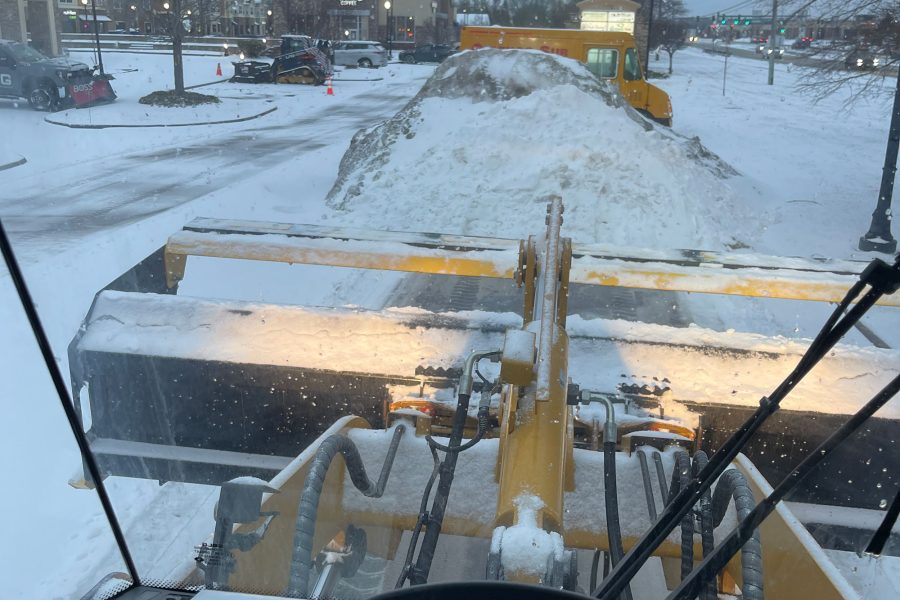
Plowing moves snow off paved surfaces and pushes it to designated stacking areas. Stacking compacts those piles to preserve parking capacity. Relocation moves accumulated piles when they begin cutting into parking counts or blocking sight lines. Hauling physically removes snow from the property when there is no longer viable space to stack it on-site.
Deicing is a separate operation from plowing. It may happen before a storm as anti-icing, after plowing to treat residual ice, or as a return visit during freeze-thaw cycles. Each of these is a billable event depending on how your contract is written.
Sidewalks, ADA-compliant routes, building entries, fire access lanes, and loading docks each carry their own response expectations. On tighter commercial sites, failing to define who handles which zone in the scope is one of the most common sources of disputed invoices and uncleaned areas mid-storm.
Local Compliance Rules That Vary by City
If your properties span the east metro and Hudson, the sidewalk deadlines and snow placement rules are not uniform. Building a service plan around one generic standard will leave at least one property out of compliance.
- Hudson, Wisconsin: Property owners and occupants must clear abutting sidewalks within 24 hours after a continuous snowfall ends. If ice cannot be fully removed, nonskid material must be applied. If the city clears the walk and the owner has not, the cost is billed to the property and unpaid balances can become a special tax. Hudson also restricts snow deposits onto public property, including boulevards and streets, without permission, which means your contractor’s stacking plan must account for legal placement before the first storm.
- Lakeville, Minnesota: Owners have 48 hours after the last snow or ice is deposited to clear abutting sidewalks. During extended multi-day events, clearing is required on a rolling basis within that window, not just once the storm ends entirely. That distinction matters for properties during the two- and three-day events that hit the south metro every few years.
- Rosemount, Minnesota: Rosemount enforces winter parking restrictions from November 1 through March 31, banning street parking from 2 a.m. to 6 a.m. and any time snow accumulation reaches two inches until streets are plowed curb to curb. Streets serving commercial businesses are designated a higher plowing priority, but that also means your lots and access drives need to be ready when city clearing finishes and employee and customer traffic resumes.
- Woodbury, Minnesota: Pushing, blowing, shoveling, or storing snow onto or across public roadways is a direct violation of city code and Minnesota statute. This is not just a contractor problem, the property is responsible too. Woodbury also notes that average city snow removal operations take eight to nine hours under average conditions, which reinforces why commercial sites need defined service triggers and priority zones before a storm starts rather than same-day requests after contractor routes are already running.
Understanding Commercial Snow Contract Structures
The pricing model matters as much as the price. Three structures are most common for commercial properties in this region, and each carries different risk and budget implications.
| Contract Type | How Billing Works | Best Fit | Main Watchout |
|---|---|---|---|
| Per-Event | One charge per defined storm event based on snowfall amount, timeframe, and ice conditions | Properties that want to pay proportionally to actual winter activity | Scope of “one event” must be clearly defined or disputes arise |
| Per-Occurrence | Separate charges for each service within an event, plowing and each salt application billed individually | Sites with complex needs and frequent return visits | A heavy storm with multiple deice returns can push costs higher than expected |
| Seasonal | Fixed fee covering a defined service bundle for the contract term | Properties prioritizing budget predictability across a full winter | Low headline price may exclude deicer, or trigger extra charges after a usage cap is hit |
Two terms that appear in seasonal contracts deserve attention before signing. A cap sets the maximum number of events or deicer applications included before extra charges apply. A floor sets a minimum charge even in a light winter. All-inclusive deicer language means materials are covered; anything short of that means materials may be billed separately or excluded above a threshold.
How to Review a Commercial Snow Scope Before You Sign
A contract that looks complete can still have gaps that create problems in February. Work through these points before finalizing any commercial snow agreement:
- Define trigger depths and ice-event triggers. At what snowfall accumulation does service begin? Is there a separate trigger for freezing rain or sleet events with no measurable snow?
- Map priority zones. Building entries, ADA routes, loading docks, fire access lanes, and drive-throughs should be designated as higher priority than outer rows of parking. Get this in writing, not implied.
- Assign sidewalk and entry responsibility explicitly. Who clears the walk from the parking lot to the front door? Who handles the covered entry overhang? Gaps between “lot” and “building” scope are where injuries happen.
- Clarify deicing materials and application method. Is it included or billed separately? Is there a defined application rate, or does the crew apply at discretion? Minnesota’s Smart Salting training covers calibrated application as a cost-reduction and liability-management tool, ask whether your contractor follows a structured materials program.
- Set rules for snow stacking, relocation, and hauling. Where can snow be legally piled on your site? At what pile height or parking-space loss does relocation become required? When is hauling triggered, and is it included or a separate line item?
- Require service documentation. Event logs, GPS or photo verification, and time-on-site records are the evidence you need if a slip-and-fall claim names your property. Ask what records are produced after each service visit and how they are delivered.
Salt Use, Anti-Icing, and Where Overapplication Costs You Twice
The Minnesota Pollution Control Agency’s Smart Salting program makes a clear point: physical snow removal is the first line of defense, and deicer is most effective when applied after surfaces have been cleared, not as a substitute for clearing. Organizations that have adopted structured salt-use practices have reduced their deicer volume by 30 to 70 percent while lowering material costs and reducing pavement and infrastructure damage.
For east metro commercial properties, the practical issue is freeze-thaw cycles. A lot that looks plowed clean in the afternoon can refreeze by 10 p.m. around building entries, shaded sidewalk sections, loading areas, and low drainage spots. These zones are not solved by lot plowing alone, they require a site-specific plan that identifies them in advance.
Overapplying salt in those areas does not necessarily fix the refreeze problem, and it accelerates damage to concrete joints, entry matting, and landscape areas adjacent to walks. A contractor with a calibrated, condition-based deicing approach is a more meaningful signal than one who simply promises “we salt when needed.”
Scope Gaps That Create Problems Mid-Winter
Most commercial snow disputes do not trace back to a contractor that did not show up. They trace back to scope language that did not define what “showing up” meant. The most common gaps:
- Assuming hauling is included when the contract only covers plowing and stacking, once piles reach a problematic size, the cost conversation starts from scratch
- Not specifying legal snow placement on the site, leaving the contractor to push toward the street or boulevard in tight situations, which creates code violations in Woodbury and Hudson
- Ignoring refreeze zones at building entries and shaded walks in the service plan, these areas need separate attention beyond standard lot runs
- Choosing based on headline seasonal price without checking whether deicer is included, capped, or excluded above a threshold
- Failing to require event logs or service verification, which matters most when you need documentation for a liability claim or a dispute over billing
Schedule Your Commercial Snow Removal Service with LNG Landscapes
LNG Landscapes provides Commercial Snow Removal for office, retail, industrial, and multi-site properties across Woodbury, Rosemount, Lakeville, Stillwater, and Hudson, Wisconsin. If you manage a commercial property in MN or WI and want a scope review before the season starts, now is the time to get site-specific details in place, trigger depths, priority zones, sidewalk compliance timelines, deicing approach, and hauling terms, before the first storm has your contractor’s routes already locked. Call us at 651-302-0266 to talk through your property’s needs.